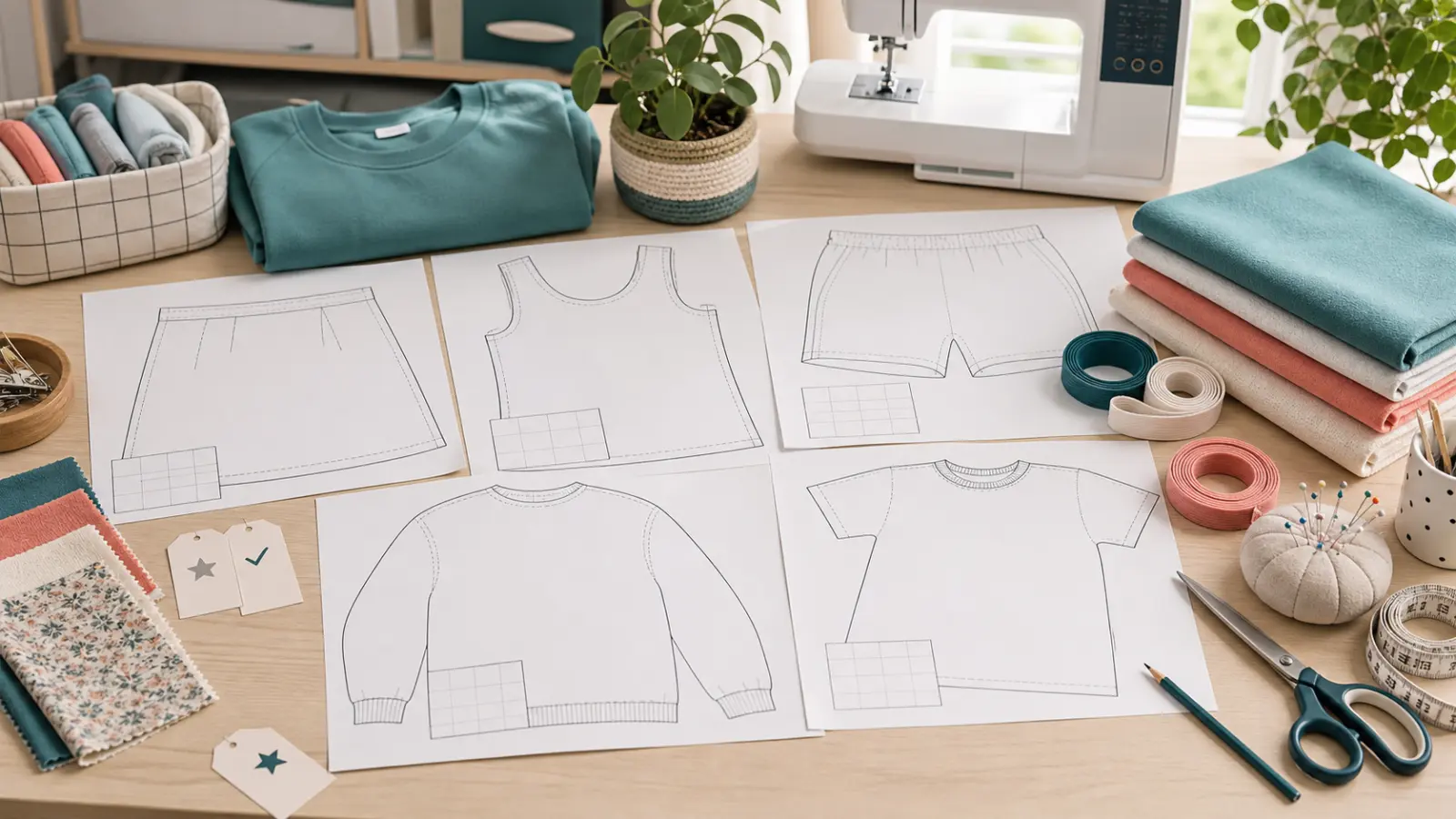
Starting to sew is much easier when your first project is simple, wearable, and doesn’t require “advanced” construction details like complex collars, tricky plackets, or heavy hardware. This article is a beginner-friendly selection of real patterns from ProstoLekala — chosen for clear construction, straightforward finishing, and a fast, satisfying result.
You’ll find practical, everyday items that help you build skills step by step: a skirt with an elastic waist, basic tops and a tank, knit shorts, a cozy sweatshirt, easy pants, a classic men’s T-shirt, simple men’s underwear, and a children’s skirt. If you like learning with guidance, ProstoLekala also has step-by-step tutorials in the Sewing Master Classes section.
How we selected beginner-friendly patterns
- Fewer pattern pieces: simple silhouettes and a clear assembly sequence.
- Easy finishing: elastic waistbands, simple hems, minimal hardware.
- Predictable fit: relaxed or straightforward shapes with fewer tricky adjustments.
- Quick wins: projects you can realistically finish in one weekend.
- One skill at a time: bias binding, cuffs, or a simple pocket — without overload.
- Only real ProstoLekala products: each item below links to an actual product page.
Top ProstoLekala patterns for beginners
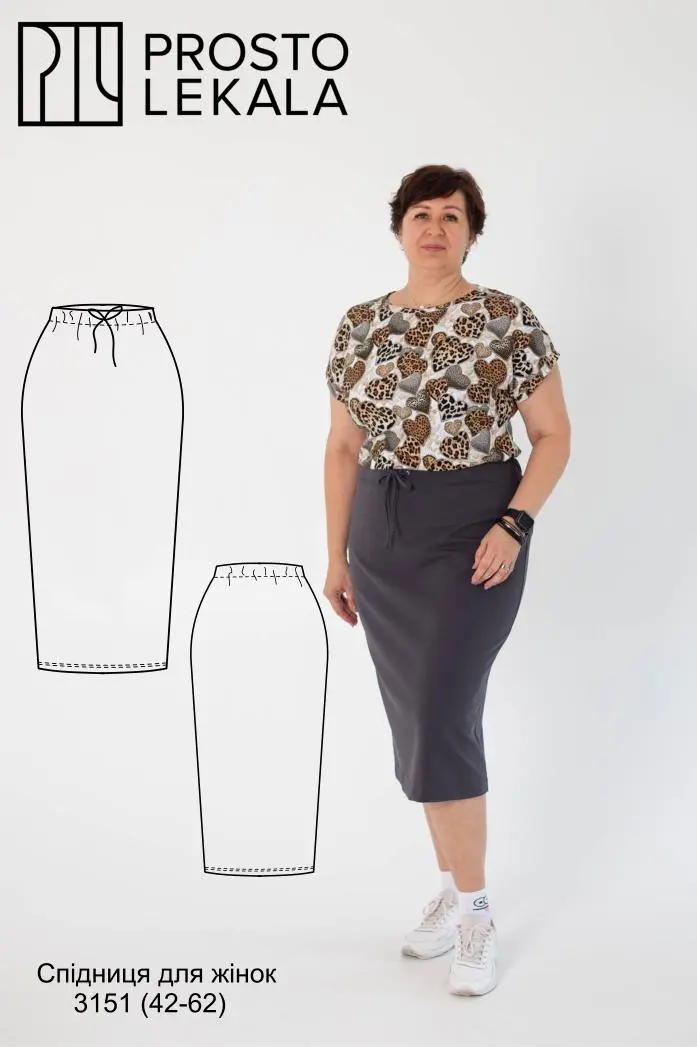
Pattern 3151 Skirt for Women
A great first skirt because the construction is forgiving: no zipper, and the waistband is built around elastic. The design is made from knit fabric (two-thread футер), which is comfortable for everyday wear, and the decorative drawstring adds a finished look without making the sewing difficult.
- Fabric: sewn from two-thread “futer” knit; patterns suit stretch fabrics with similar properties.
- Waist: one-piece waistband with elastic.
- Detail: decorative drawstring on the front.
- Hem: recommended coverstitch finish.
- You’ll need: 4 cm elastic, 2 eyelets, and a drawstring.
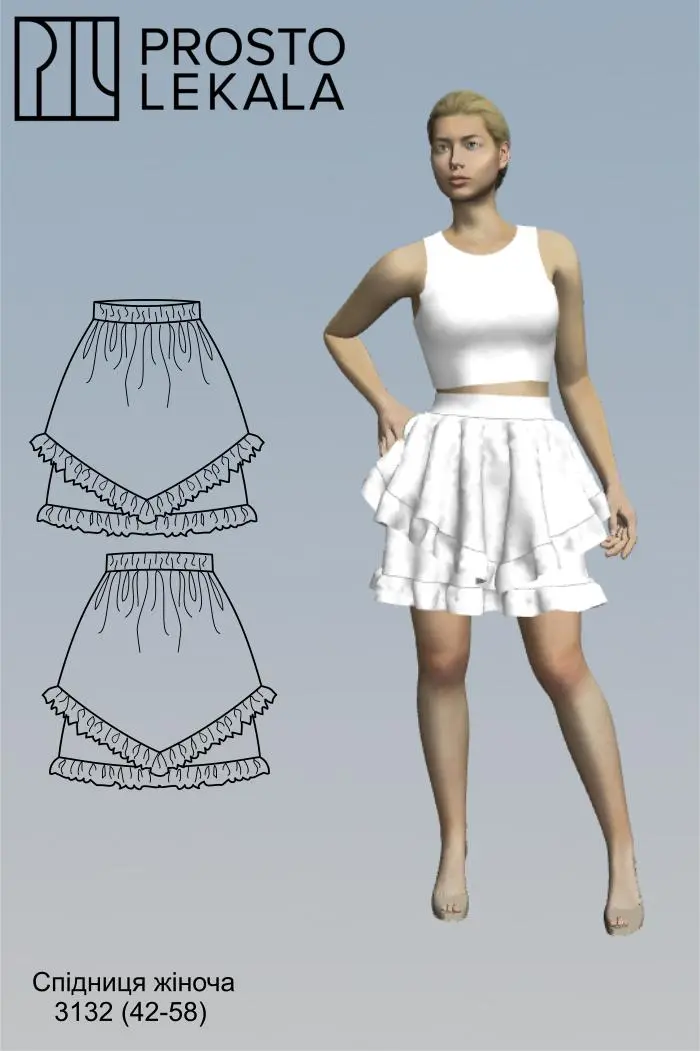
Pattern 3132 skirt for women
This is a smart choice if you want something a bit more “special” while keeping the sewing approachable. The skirt is two-layered, with a separate elastic waistband and lace at the hem of both layers. It’s a good beginner project for practicing neat decorative finishing.
- Fabric: suitable for woven textiles such as Tencel denim, cotton, broderie anglaise, satin, and similar fabrics.
- Construction: two-layer skirt; the upper layer sides slope downward.
- Waist: separate waistband with elastic.
- Trim: lace at the bottom of both layers.
- You’ll need: 6 cm lace and 5 cm elastic.
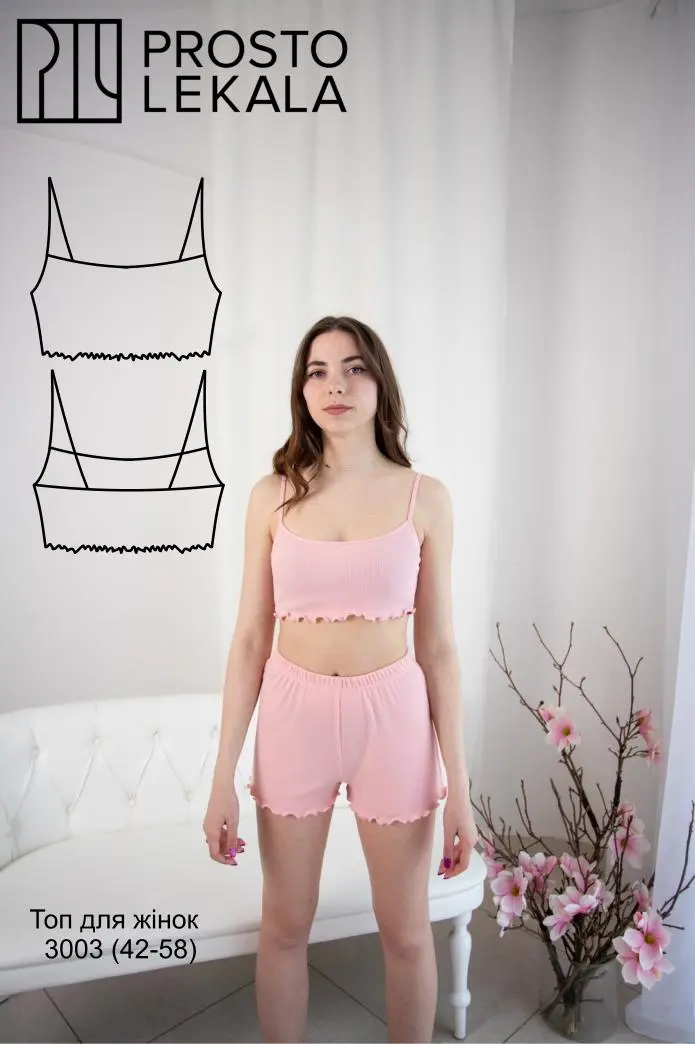
Pattern 3003 Top for Women
A small project with a fast payoff. This top is made from rib knit (“рубчик”) and features rolled straps. Because the garment is compact and the design is straightforward, it’s a confidence builder — perfect for learning to control stretchy fabric and keep seams clean.
- Fabric: rib knit with stretchability around 10–11 cm (as described on the product page).
- Design detail: rolled straps.
- Beginner benefit: minimal pieces and quick assembly.
- Planning: fabric consumption is listed by size on the page.
- Tip: test your stitch settings on scraps of the same knit before sewing.
Pattern 3072 tank top for women
A wearable basic that teaches an important skill: cleanly finishing neckline and armholes. In this model, the armholes and neckline are finished with bias binding, while the hem is finished with a coverstitch. It’s a simple silhouette, so you can focus on neat finishing.
- Fabric: knit fabric with stretchability from about 10 cm to 12 cm (as described on the page).
- Finishing: armholes and neckline finished with bias binding.
- Hem: coverstitch finish recommended.
- Skill level: beginner-friendly; the “main new step” is bias binding.
- What you’ll need: bias binding (store-bought or made from fabric strips).
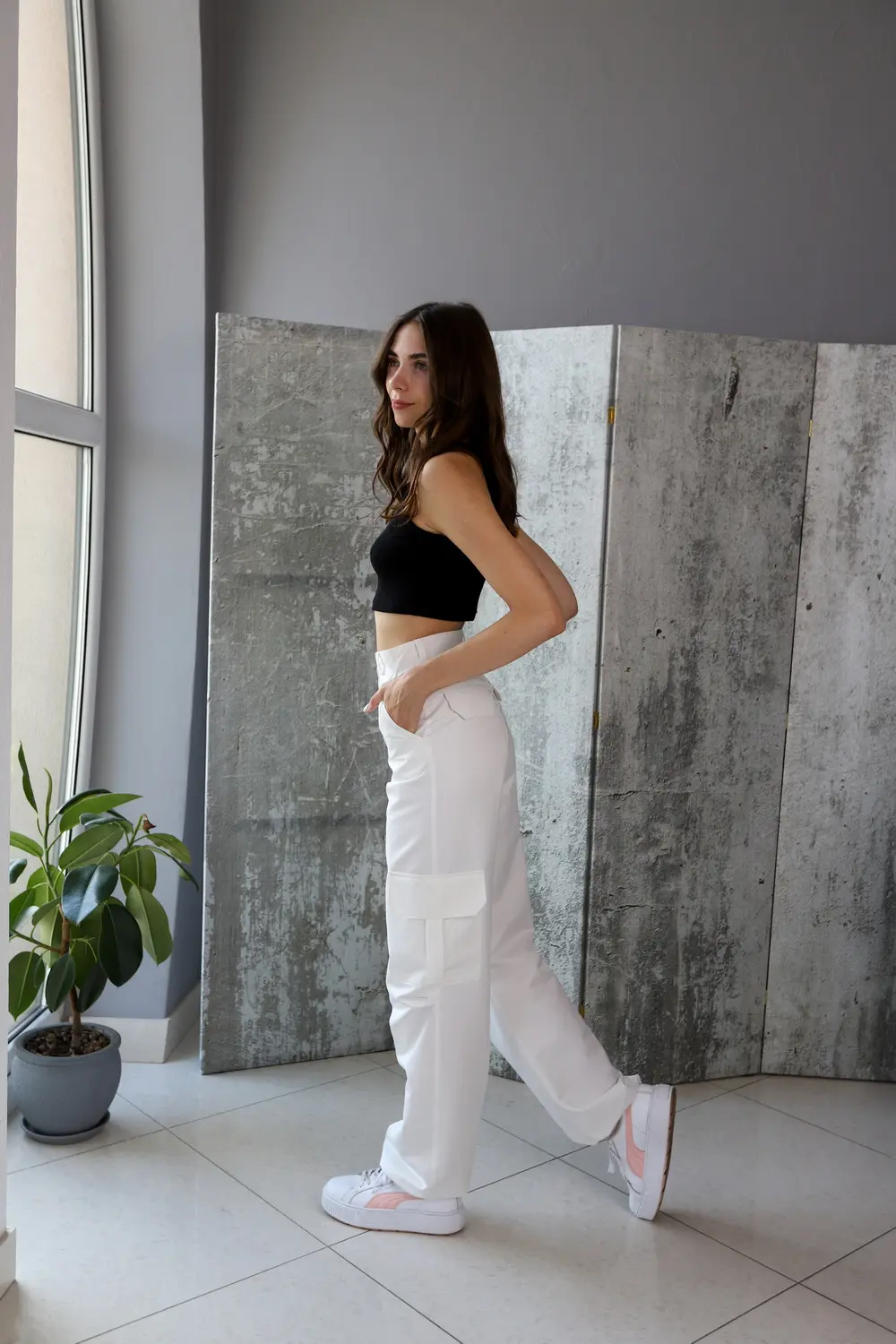
Pattern 3067 women's shorts
Comfortable knit shorts are one of the best beginner projects: fast to sew, practical, and forgiving. This pattern includes a separate waistband, a pocket with a cut-off side piece, and a simple hem finish — a great stepping stone toward pants and full lounge sets.
- Fabric: knit fabrics such as two-thread “futer” and loop-back three-thread knit.
- Waist: separate waistband.
- Pocket: front pocket with a cut-off side piece.
- Hem: coverstitch finish.
- You’ll need: 4 cm elastic.
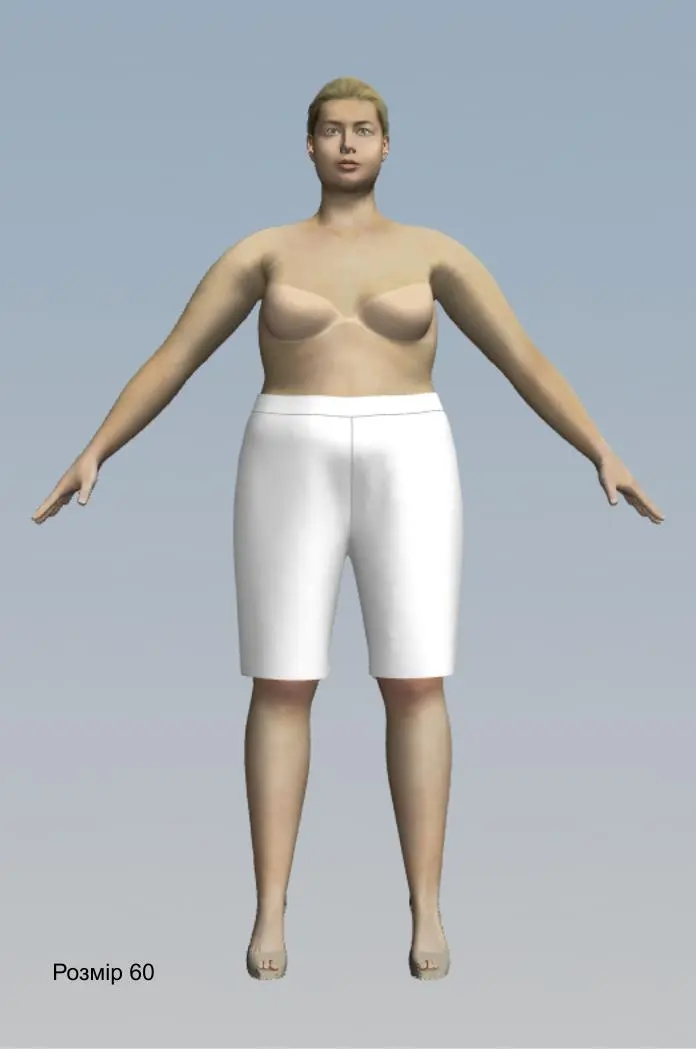
Pattern 3088 women's sweatshirt
A sweatshirt looks like a “big project,” but the construction is quite friendly for beginners when the fit is relaxed. This model is described as having a loose silhouette with a dropped shoulder line, and rib-knit finishing (кашкорсе) at the sleeve cuffs, hem, and neckline — a great way to learn clean knit finishes.
- Fabric: sewn from two-thread “futer” knit; designed for dense knit fabrics.
- Fit: loose silhouette.
- Sleeve: dropped shoulder line.
- Ribbing: cuffs, hem, and neckline finished with rib knit (кашкорсе).
- Length: described as waist-length.
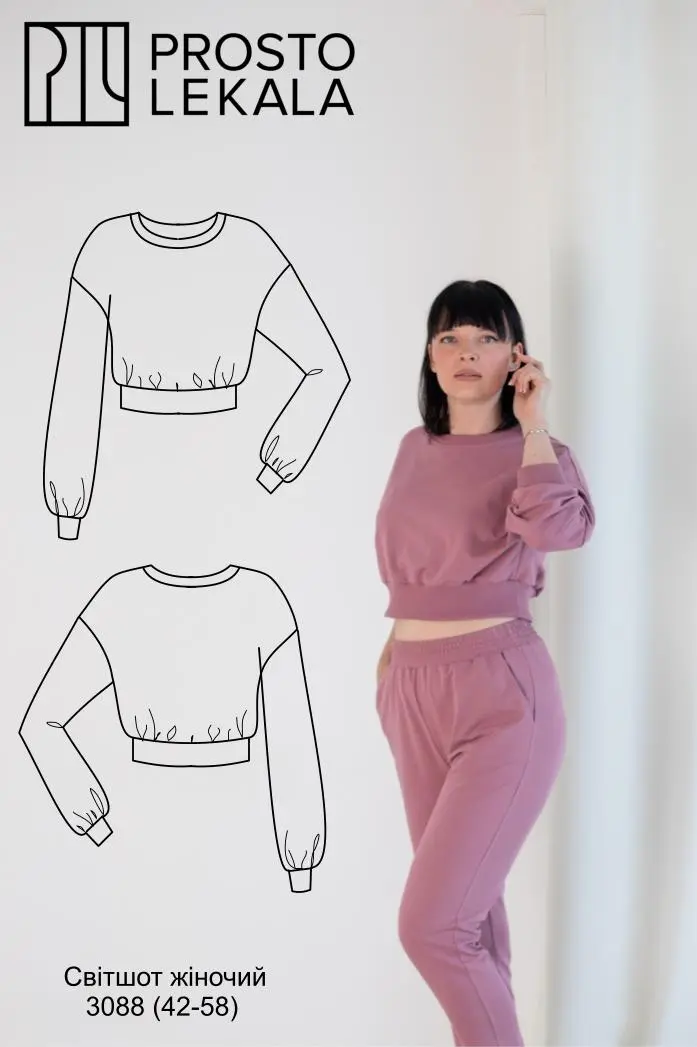
Pattern 3092 women's pants
These pants are a solid beginner “Level 2” piece: still approachable, but with useful practice. The design includes a pocket with a cut-off side piece, a separate waistband, and elastic at the hem (2.5 cm). There is no zipper, which keeps the project friendly, while still building real garment skills.
- Fabric: sewn from two-thread “futer” knit.
- Pocket: pocket with a cut-off side piece.
- Waist: separate waistband.
- Hem: pant hem finished with 2.5 cm elastic.
- You’ll need: 5 cm elastic and 2.5 cm elastic (as listed on the page).
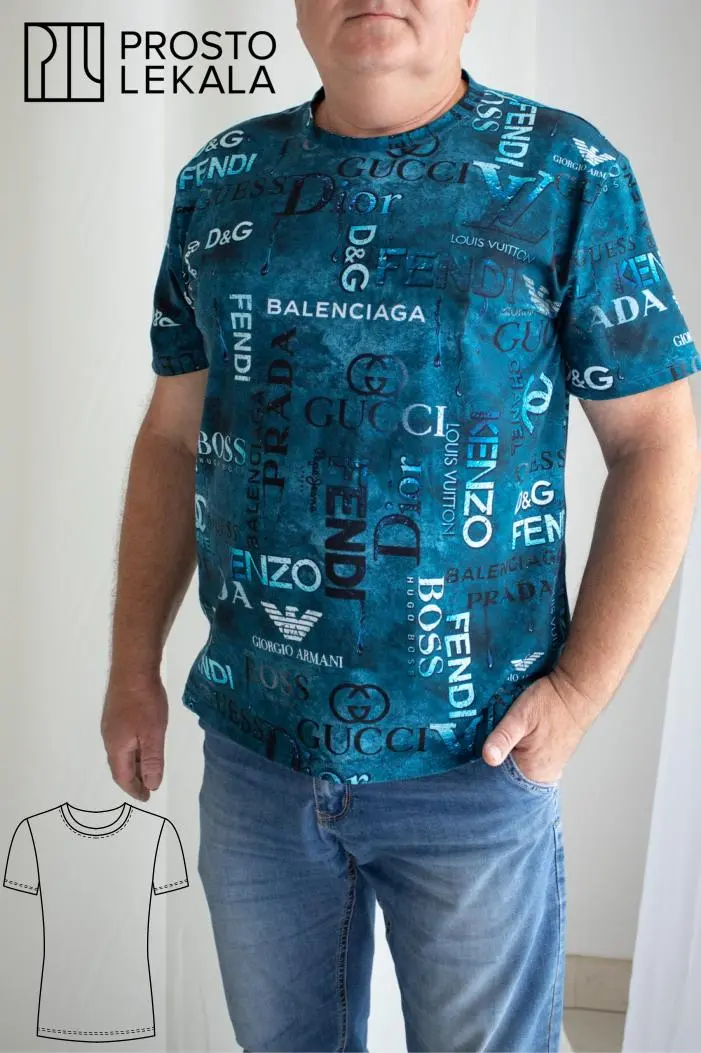
Pattern 207 men's T-shirt
A classic beginner staple: a basic men’s T-shirt with a set-in sleeve and a clean neckline finish. The product page describes it as a “small-volume” fit, made for stretch jersey (“stretch kulir”), with a neckband and coverstitched hems. Perfect for learning to sew knit basics properly.
- Fit: small-volume men’s T-shirt.
- Sleeve: classic set-in sleeve.
- Fabric: designed for stretch jersey (“stretch kulir”) or similar knits.
- Neckline: neckband.
- Hems: coverstitch finish recommended.
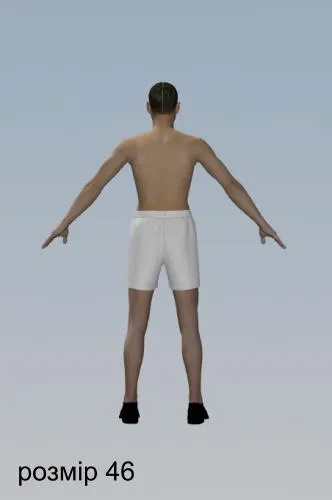
Pattern 208 men's underwear
A small, confidence-building project. The product page describes the underwear as made for cotton non-stretch woven fabrics, with no side seam and a one-piece waistband, and the leg openings finished with a simple fold-over hem. Great for practicing accuracy and consistency on a compact item.
- Fabric: cotton, non-stretch woven fabrics.
- Construction: no side seam; one-piece waistband.
- Finish: hem finished with a fold-over.
- Notions: the materials list includes 4 cm elastic.
- Beginner tip: press the hem fold before stitching to keep it even.
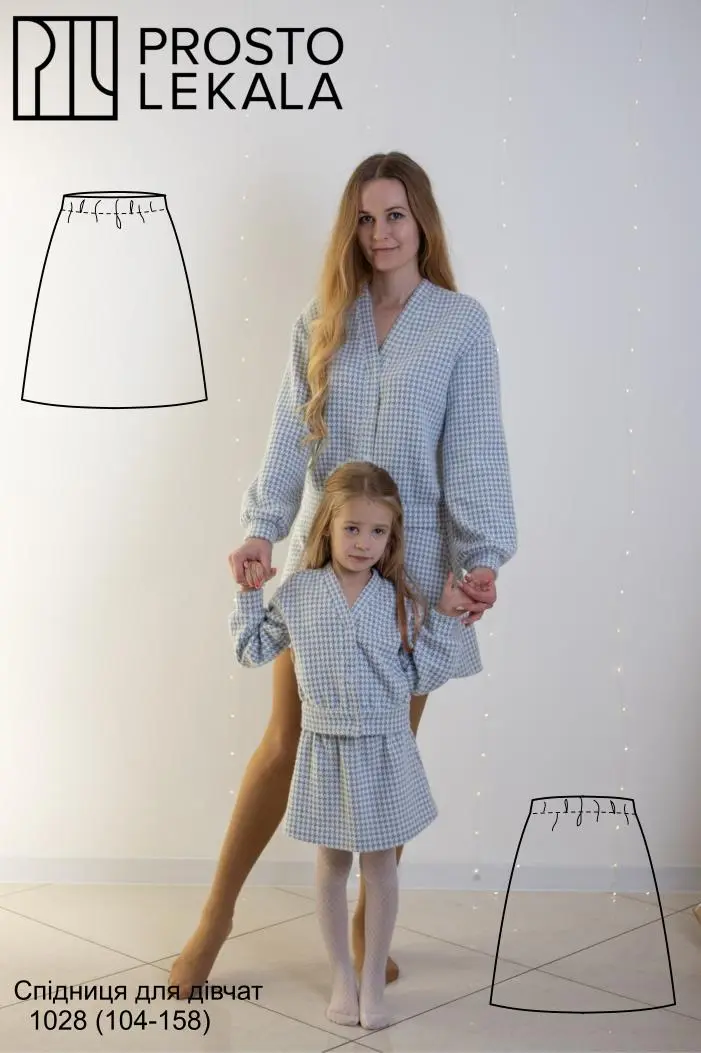
Pattern 1028 Skirt for Girls
Children’s garments are often the quickest way to build confidence, because they require less fabric and sew up fast. This skirt is described as being sewn from “rabbit” knit (a soft dense knit), with a one-piece elastic waistband. A simple, wearable result with an easy finish.
- Fabric: “rabbit” knit; suitable for soft dense knit fabrics.
- Waist: one-piece waistband with elastic.
- You’ll need: 3 cm elastic.
- Beginner benefit: minimal construction and no closures.
- Planning: fabric consumption is listed on the product page by size/height.
Beginner tips before you start
- Start with a low-risk test project: the Patterns for a Hryvnia section is great for practicing and checking fit without pressure.
- Read the product page before buying fabric: check fabric recommendations, “you’ll need” notes, and material consumption.
- Print correctly: set printer scaling to 100% and test the 10×10 cm square before printing everything.
- Prep notions in advance: elastic widths matter (2.5 cm vs 4 cm vs 5 cm), and it’s best to have them ready before you sew.
- Sew a test seam on scraps: especially on knits, stitch choice and tension make a huge difference.
- Press as you go: pressing after each step improves accuracy and the final look.
- Mark notches and match points: they prevent twisting and misalignment.
- Use step-by-step guidance: ProstoLekala’s Sewing Master Classes can remove guesswork from your first projects.
- Keep the first win simple: a finished basic top or skirt is the best motivation to sew the next piece.
FAQ
What do I receive after purchasing a digital pattern?
ProstoLekala product pages explain that after payment the digital pattern is delivered to your account as a zip archive. It typically includes a technical document (with a technical drawing, finished measurements and material requirements), plus pattern files for printing (PDF) and for plotter printing (PLT), along with recommended layouts.
How do I print the pattern at home without scaling errors?
Follow the “About PDF” instructions shown on the pattern pages: print at 100% scale, print the first page with the test square, and confirm the square measures 10×10 cm. Only then print the remaining pages.
How do I choose the right size?
The size guidance on the product pages explains a simple method for adults: measure chest circumference and divide by two to determine size, then cross-check waist and hips on the chart. For children, measure height and verify key measurements on the chart.
Do the pattern pieces include seam allowances?
In the “What you will receive” sections on ProstoLekala product pages, it is stated that pattern pieces for one size include seam allowances, grainline, notches, and auxiliary outlines, which makes the process easier for beginners.
Can I order printed patterns instead of taping A4 pages?
Many product pages offer a printing option and also mention printing technical documentation as a separate service. The pages also note that printed pattern delivery is available only within Ukraine.
Conclusion
For beginners, the best pattern is the one you finish — and wear. Choose a simple silhouette, follow the fabric and notions list from the product page, print carefully using the test square, and build confidence one clean project at a time. Pick one model from this TOP list, open the product page, prepare the materials — and enjoy your first successful sew.
- Women’s Quilted Jacket with Teddy: Step-by-Step Sewing Masterclass
- Women’s hooded windbreaker
- Sewing a windbreaker, pants, and shorts for girls
- How to sew a women’s faux-fur dickie with lining 3231
- Women’s denim jacket with snaps
- Master class: sewing a women’s quilted jacket with a hood and a drawstring casing
- Girls’ Dress with Double Ruffles and Flutter Sleeves
- Sewing tutorial for Coat 3233 with lining
- Women’s lined vest with a back waist belt
- Warm Shirt for Children 1097