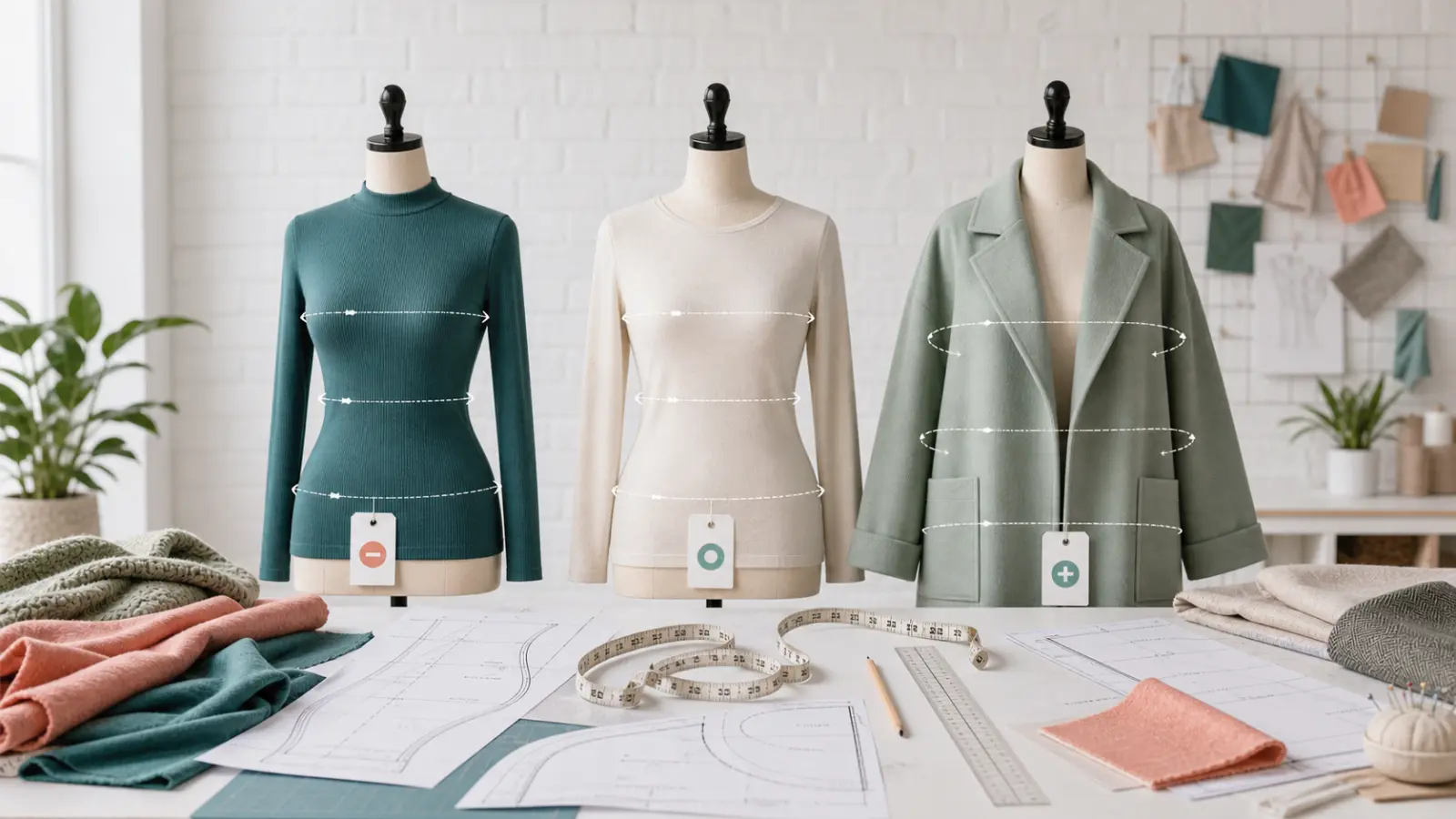
Ease allowance is the difference between body measurements and the garment measurements built into a pattern. It defines the silhouette and comfort level: close-fitting, semi-fitted, relaxed, or oversized. Understanding ease helps you choose the right size and get the fit you expect—before you cut your fabric.
Positive, zero, and negative ease: what they mean
- Positive ease (+) adds room for comfort and layering—common in outerwear and relaxed silhouettes.
- Zero ease (0) sits close to body measurements—fit depends heavily on construction and fabric behavior.
- Negative ease (−) relies on fabric stretch and creates a snug fit—typical for underwear and thermal layers made from knit fabrics.
Where to find ease information on ProstoLekala
On ProstoLekala, each model page includes a dedicated “Ease allowance” section. You’ll also see “Choosing the size” guidance and a note that finished garment measurements are available in the gallery for each model. This combination makes it easier to predict real fit and volume.
Helpful catalog sections:
- Patterns for Women’s Coats and Trench Coats (often with positive ease)
- Patterns for underwear and thermal underwear (often with zero or negative ease)
- Sewing Master Classes (step-by-step tutorials tied to specific patterns)
Real examples: how ease changes the silhouette
Compare two clear examples to see how ease works in different garment types:
- Outerwear with noticeable room: Pattern 325 women’s coat — ease allowance: Chest +14 cm, Waist +38 cm, Hips +12 cm.
- Thermal layer with negative ease: Pattern 398 longsleeve for women — ease allowance: Chest −8 cm, Hips −10 cm.
A practical size-selection workflow (with ease in mind)
- Measure yourself: bust/chest, waist, hips (and height if needed).
- Pick the base size using the “Choosing the size” instructions on the model page.
- Check the “Ease allowance” table to understand how much volume (or negative ease) is built into the pattern.
- Verify finished garment measurements in the model gallery—this is the best way to estimate the final fit on your body.
- Consider fabric properties (stretch, density, drape). Negative ease only works as intended when the knit fabric actually stretches enough.
- Print at correct scale: the PDF section on model pages recommends printing at 100% and first checking the 10×10 cm test square before printing everything.
When you may want to adjust your choice
- If you prefer a looser fit, focus on finished garment measurements and choose a size that gives your desired final circumference.
- If your knit stretches less than expected, negative ease can feel too tight—double-check finished measurements and fabric stretch.
- If you plan to layer (for example, a sweater under a coat), choose patterns with enough positive ease or confirm the final measurements in the gallery.
To explore styles and compare fit across models, start from Women’s Clothing Patterns, then use each product page’s “Choosing the size,” “Ease allowance,” and gallery measurements to lock in the fit you want.
- Warm Shirt for Children 1097
- Sewing Master Class for Jacket 1096, Skort 1095, and Capri Pants 1093–1094
- Girls’ zip-up jacket with elasticated cuff
- Balloon Sundress with a Double Bodice
- Women’s denim jacket with snaps
- How to sew a lined biker jacket 3240
- Women’s hooded windbreaker
- How to sew a wrap dress using pattern 3251
- How to sew a women's jacket 3243
- Women’s Quilted Jacket with Teddy: Step-by-Step Sewing Masterclass